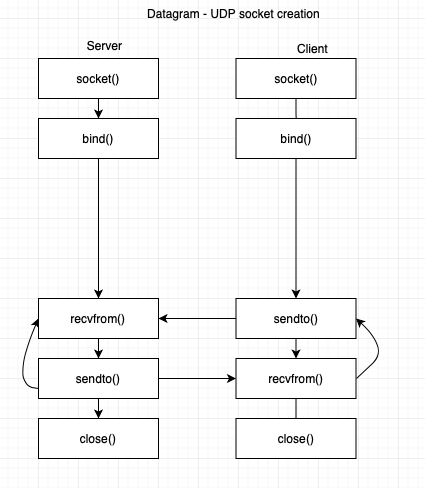
The above image shows the sequence of steps for a Server and client to create a UDP client server communication.
For creating a UDP server:
1. Create a socket using “socket()”
2. bind to an address using “bind()”
3. Wait for the data to be received using “recvfrom()”
4. Send the data to client using “sendto()”
5. Close the connection using “close()”
For creating a UDP client:
1. Create a socket using “socket()”
2. bind to an address using “bind()”
3. Send the data to server using “sendto()”
4. Receive the data from the server using “recvfrom()”
5. Close the connection using “close()”
Important header files to be included in UDP socket programming:
#include <sys/socket.h> It contains the data structures required for socket
#include <netinet/in.h> It has the constants and structures required for Internet domain address.
#include <sys/types.h> It has definitions of number of data types used for system calls.
Now let us understand the API’s involved in creating a server and client.
Important API used in UDP socket programming:
1. Create a socket using “socket()” system call
int sockID =socket(family, type, protocol);
sockID is a file descriptor.
family: It is an integer in communication domain.
There are 2 possible domains:
1. Unix Domain: Where 2 process share the same file system. In that case family will be “AF_UNIX”
2. Internet Domain: They are 2 hosts on the Internet.In that case family will be “AF_INET”
type: It is the type of communication.
SOCK_STREAM: For TCP
SOCK_DGRAM: For UDP
protocol: It will specify the protocol.
IPPROTO_TCP, IPPROTO_UDP.
But it is always set to 0, so that OS will choose appropriate protocol.
This API will return -1 upon failure.
2. Closing a socket using “close()” system call.
A socket created must be closed after the transmission is completed.
status = close(sockid);
sockid: It is the file descriptor of the socket being closed.
status: 0 if successful -1 if error.
3. Important Data Structures for specifying address:
1. sockaddr:
It defines a generic data type for address. We use sockaddr_in to be casted to sockaddr.
struct sockaddr{

	unsigned short sa_family; // address family AF_INET
	char sa_sata[14]; // Family specific address information
}
2. in_addr:
It is the internet address
struct in_addr{
	unsigned long s_addr; // internet address 32 bits
}
3. sockaddr_in
struct sockaddr_in{
	unsigned short sin_family; // address family AF_INET
	unsigned short sin_port; // assign the port
	struct in_addr sin_addr; // assign the ip address
	char sin_ero[8];

}
4. Assign address to a socket using “bind()” api
int status = bind (sockid, &addrport, size)
sockid = It is the socket descriptor that we created earlier.
addrPort: it is the filled part of the structure sockaddr_in, casted to sockaddr.
size: It is the size of sockaddr_in.
status: It will return -1 if failure.
5. Send the data using “sendto()”:
int count = sendto(sockid, msg, msgLen, flags, &serverAddr, addrlen);
msg: It is the message to be transmitted.
msgLen: Length of the message
flags: Special options, usually 0
serverAddr: Address of server
addrlen: address of sockaddr_in.
6. Receive the data using “recvfrom()”:
int count = recvfrom(sockid, recvBuf, bufLen, flags, &clientAddr, addrlen);
recvBuf: It is the message to be received.
bufLen: Length of the message
flags: Special options, usually 0
clientAddr: Address of client.
addrlen: address of sockaddr_in.
Code for UDP server:
#include <stdio.h>
#include <stdlib.h>
#include <string.h>
#include <sys/socket.h>
#include <sys/types.h>
#include <netinet/in.h>
#include <arpa/inet.h>

int main( )
{

  int port = 1234;
  int sockfd;
  struct sockaddr_in si_me, si_other;
  char buffer[1024];
  socklen_t addr_size;

  sockfd = socket(AF_INET, SOCK_DGRAM, 0);

  memset(&si_me, '\0', sizeof(si_me));
  si_me.sin_family = AF_INET;
  si_me.sin_port = htons(port);
  si_me.sin_addr.s_addr = inet_addr("127.0.0.1");

  bind(sockfd, (struct sockaddr*)&si_me, sizeof(si_me));
  addr_size = sizeof(si_other);
  recvfrom(sockfd, buffer, 1024, 0, (struct sockaddr*)& si_other, &addr_size);
  printf("[+]Data Received: %s", buffer);

  return 0;
}
Code for UDP client:
#include <stdio.h>
#include <stdlib.h>
#include <string.h>
#include <sys/socket.h>
#include <sys/types.h>
#include <netinet/in.h>
#include <arpa/inet.h>

int main()
{

  int port = 1234;
  int sockfd;
  struct sockaddr_in serverAddr;
  char buffer[1024];
  socklen_t addr_size;

  sockfd = socket(PF_INET, SOCK_DGRAM, 0);
  memset(&serverAddr, '\0', sizeof(serverAddr));

  serverAddr.sin_family = AF_INET;
  serverAddr.sin_port = htons(port);
  serverAddr.sin_addr.s_addr = inet_addr("127.0.0.1");

  strcpy(buffer, "Hello Server\n");
  sendto(sockfd, buffer, 1024, 0, (struct sockaddr*)&serverAddr, sizeof(serverAddr));
  printf("[+]Data Send: %s", buffer);

  return 0;


}
Output:
[+]Data Received: Hello Server