In the previous 2 chapters we learn about MIB and different types of SIBs.
In this chapter we shall learn more about SBI1 and SIB2. As these 2 SIBs play an very important rule in UE power On procedure.
System Information Block Type 1:
Below are the information that has been sent through SIB1. Officially they are called as IEs (Information Elements)
1. Cell Access Information –
PLMN Identity List
PLMN Identity, TA Code
Tracking Area Code
Cell Identity
Intra Frequency Reselection
Cell Barred
CSG Indication
CSG Identity
2. Cell Selection Information – Minimum Receiver Level
3. Scheduling Information –
SI message type
SI Periodicity
SIB mapping Info
SI Window length
Every 80ms a new SIB1 is transmitted. Every 20ms retransmission on SIB1 happens. It is always sent in sub-frame #5 of the Radio-Frame.
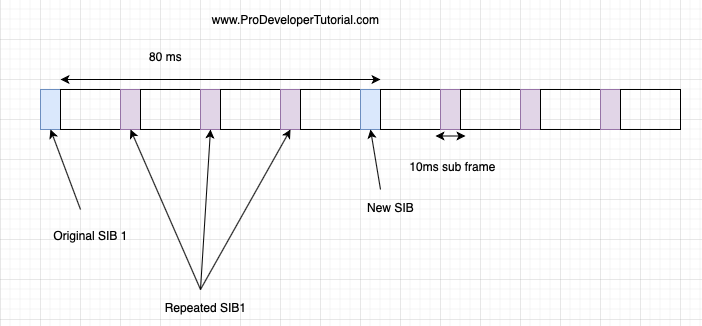
SIB1 is transmitted through BCCH -> DL-SCH -> PDSCH channels.
Direction: E-UTRAN => UE
RLC Mode: TM
System Information Block Type 2:
SIB2 has radio resource configuration information that is common for all the UEs.
1. Access Barring Information –
Access Probability factor
Access Class Baring List
Access Class Baring Time
2. Semi static Common Channel Configuration – Random Access Parameter, PRACH Configuration
3. UL frequency Information –
UL Bandwidth
additional spectrum emission
UE Timers and Constants:
T300: It will start at RRC connection REQ transmit and stops at the receipt of RRC connection setup or reject message.
T301: It will start at RRC connection Re-establishment Request and stops at receipt of RRC connection re-establishment or RRC connection Re-establishment reject.
T310: Started after receiving N310 out of sync indications (0, 50, 100, 200, 500, 1000, 2000 ms)
T311: It will start while initiating RRC CONNECTION RE-ESTABLISHMENT procedure
N310: Number of consecutive out-of-sync indications from lower layers. If reached, it triggers T310 timer.
N311: Number of consecutive in-sync indications from lower layers,time bound by T311.
SIB2 is transmitted through BCCH -> DL-SCH -> PDSCH channels.
Direction: E-UTRAN => UE
RLC Mode: TM