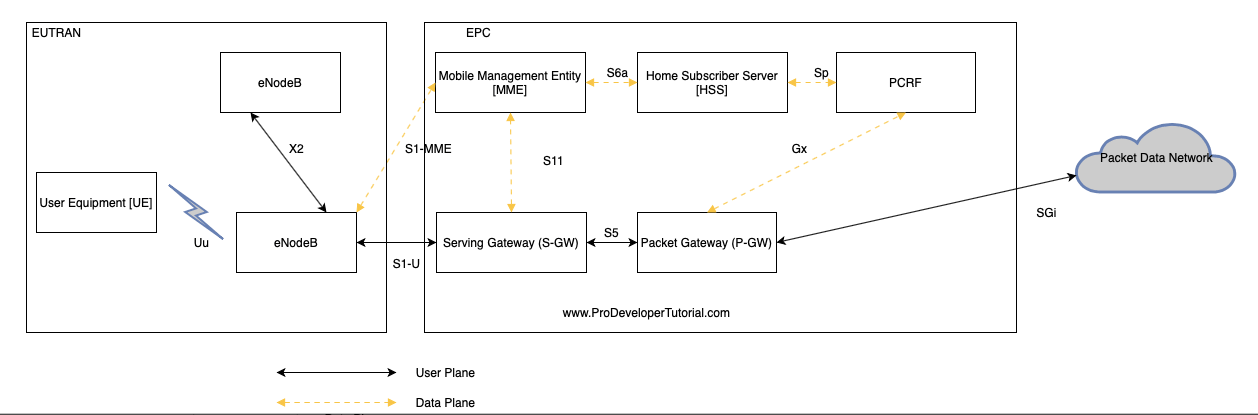
In the last chapter we saw what is the network architecture of 4G LTE.
In this chapter we shall see the brief working of all the components present in the architecture.
Below are the elements present in LTE
1. eNodeB
2. MME
3. Serving Gateway
4. Home Subscriber Server
5. PDN gateway
6. sPCRF
eNodeB Function:
* Radio Resource Management
* Radio Bearer Control
* Radio admission control
* Connection mobility control
* Up-link / Down-link scheduling
* IP header compression and ciphering of the user data stream
* MME selection
* Paging
* CMAS
MME Function:
* Non-Access Stratum (NAS)
* NAS signaling security
* Signaling for mobility between 3PGG access networks
* Idle mode user tracking
* Tracking area list management
* PDN gateway, S-GW selection
* Roaming – S6a interface to HSS
* Authentication
Serving Gateway Function:
* Local mobility anchor for inter-eNodeB handover
* EUTRAN down-link packet buffering- while UE is being paged.
* Lawful intercept
* Packet routing and forwarding
* Transport Level packet marking
* Accounting for inter-operator charging
* Accounting per UE
Home Subscriber Server Function:
* Storage of Auth keys, QoS profile, APN profile
* Address of currently serving MME
PDN gateway Function:
* Lawful Intercept
* IP address allocation
* Transport level marking for DL
* Downlink rate enforcement based on AMBR [Aggregate Maximum Bit Rate]
* Accounting per UE
PCRF Function:
* Interface with proxy – call session control function
* Interface with PDN – GW to convey policy decisions and profiles.
* Decides how services will be treated in PDN GW according to user policy.