Bearer means a “carrier”, which carries something form one point to another.
LTE provides end to end service using multiple LTE bearers as shown in the image below:
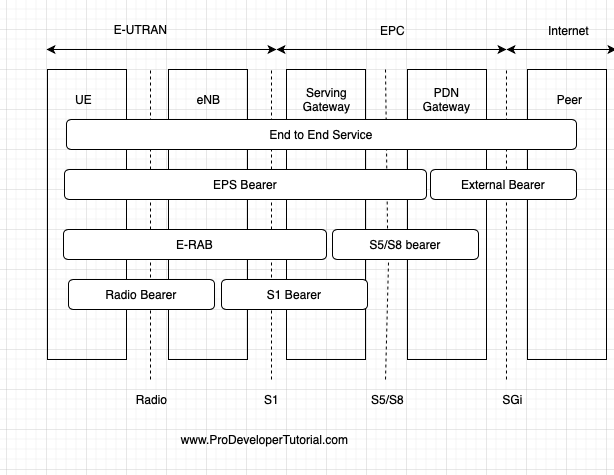
From the image above we can know that:
End To End communication = EPS Bearer + External Bearer
EPS Bearer = E-RAB + S5/S8 bearer
E-RAB = Radio Bearer + S1 bearer
Below is how a bearer is established:
1. When an UE register with the network using “Attach Procedure” EPS bearer will be established. EPS bearer is also known as default EPS bearer and is used to provide always on connectivity.
2. There are dedicated EPS bearers, they can be established to connect to other PDN gateways and to provide different LTE QoS.
3. EPS bearer is generated with the combination of E-UTRAN radio access bearer, S5 bearer and S8 bearer.
4. S1 bearer provides connectivity between eNB and Serving Gateway.
5. S5 interface provides connectivity between serving gateway and PDN gateway
6. S8 interface provides roaming connectivity.
7. Radio bearer is used to provide air connectivity between UE and eNB.
So what is the need of Bearers?
We need bearers for providing QoS for a subscriber. So in LTE network QoS is implemented with the help of bearers.
We need bearers to provide different types of QoS service. For example, for VoIP call we need a better QoS because there should not be any delay in the voice.
But while browsing INTERNET, some delay is acceptable. So in order to support multiple QoS different bearers are setup within EPC.
So in LTE, QoS is applied on Radio bearer, S1 bearer and S5/S8 bearer, collectively called as EPS bearer.
How many types of bearers are available in LTE?
There are 2 types of bearers available in LTE.
Default Bearer :
1. A default bearer is established when a UE is attached to LTE
Dedicated Bearer :
1. Dedicated bearer is created when there is need to provide Qos for specific applications.
2. They provide dedicated tunnel for one or more specific traffic like VoIP, Video etc.
3. dedicated bearer uses Traffic Flow Template (TFT) to give dedicated services.
Example:
Default bearer: It is used for signaling messages (sip signaling) related to IMS network. It uses qci 5
Dedicated bearer: It is used for VoLTE VoIP traffic. It uses qci 1 and is linked to default bearer 1
LTE QoS classification
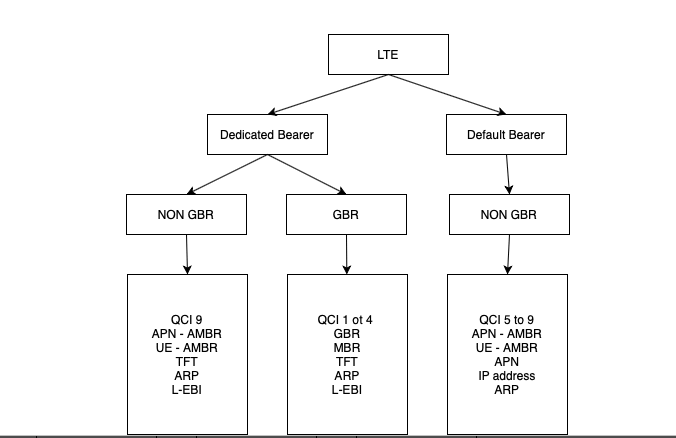
Below is the QOS classifier:
All the bearers are associated with QoS class of identifier (QCI). The classifier is as shown below.
I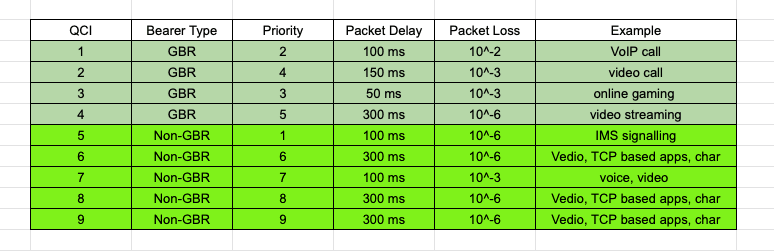
Depending on the bit rate it is again divided into 2 types
Minimum guaranteed bit rate (GBR)
1. They can be used with the application such as VoIP.
2. For such application they have an associated GBR value for which dedicated resource are permanently allocated.
3. Bit rates higher than the allocated GBR may be allocated if resources are available.
Non-GBR:
1. They do not guarantee any particular bit rate.
2. Web browsing applications or FTP can use this Non GBR.
Few important points regarding bearer:
1. Each UE will have only one default EPS bearer per PDN.
2. PDN might be Internet or corporateVPN or IMS.
3. How many IP address can you mobile have at the same time?
At max, it can have 3 different IP address if it is connected to 3 different PDN.
4. PDN GW can allocated multiple dedicated EPS bearer to the UE depending upon the quality of service requested by UE.
5. Which bearer is having higher priority? Default Bearer or Dedicated Bearer?
– Default EPS bearer. Because this is the first bearer allocated to UE.
You can learn more about LTE Bearer Types in this specification: 3GPP reference TS 36.300