Introduction to fork() system call:
“fork()” system call is used to create a new process.
The child process returns zero and the parent process returns a number greater then zero.
The new process created by fork() is a copy of the current process except for the returned value.
So to summarize fork() will return:
Greater than 0 to parent process.
Equal to 0 to child process
Less than 0 in case of error.
Function prototype of fork()
#include

pid_t fork(void);
pid_t vfork(void);
If fork() is successful,
It will return a number of type “pid_t” which is greater than 0 and represents the PID of the newly created child process.
The child process, fork() returns 0.
If fork() fails then its return value will be less than 0.
vfork() is a more efficient version of fork(), which does not duplicate the entire parent context.
Let us understand fork() with number of examples:
Example 1:
#include <stdio.h>
#include <sys/types.h>
//for more tutorials on C, C++, STL, DS visit www.ProDeveloperTutorial.com

#include <unistd.h>
int main()
{

    fork();

    printf("Hello from www.ProDeveloperTutorial.com!\n");
    return 0;
}
Output:
Hello from www.ProDeveloperTutorial.com!
Hello from www.ProDeveloperTutorial.com!
Example 2:
#include <stdio.h>
#include <sys/types.h>
//for more tutorials on C, C++, STL, DS visit www.ProDeveloperTutorial.com

#include <unistd.h>

void myFork()
{
    // child process because return value zero
    if (fork() == 0)
        printf("Hello from Child!\n");

    // parent process because return value non-zero.
    else
        printf("Hello from Parent!\n");
}
int main()
{
    myFork();
    return 0;
}
Output:
Hello from Parent!
Hello from Child!
Example 3: fork() tree
#include <stdio.h>
#include <sys/types.h>
//for more tutorials on C, C++, STL, DS visit www.ProDeveloperTutorial.com

int main()
{
    fork();
    fork();
    fork();
    printf("hello\n");
    return 0;
}
Output:
hello
hello
hello
hello
hello
hello
hello
hello

fork ();   // f1
fork ();   // f2
fork ();   // f3

       f1       // There will be 1 child process
    /     \     // created by  fork 1.
  f2      f2    // There will be 2 child processes
 /  \    /  \   //  created by fork 2
f3  f3  f3  f3  // There will be 4 child processes
                // created by fork 3
wait() system call.
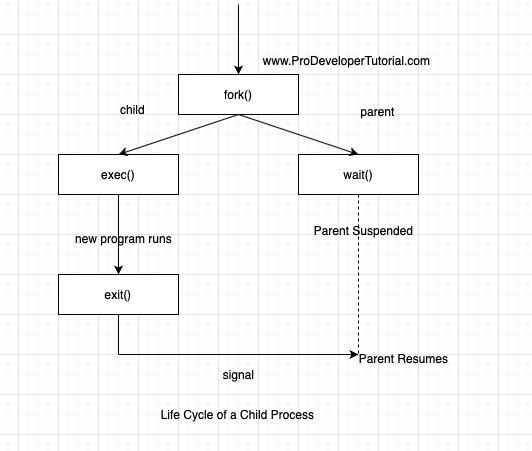
wait() system call will force a parent process to wait for a child process to stop or terminate.
wait() system call return the pid of the child or -1 for an error.
Syntax of wait system call:
int wait (int *status_location)waitpid() system call is used to wait on particular child process instead of waiting for all the child process.
Syntax for waitpid()
pid_t waitpid(pid_t pid, int *statloc, int options);Example for wait() system call:
#include <stdio.h>
#include <stdlib.h>
#include <sys/types.h>
#include <sys/wait.h>
#include <unistd.h>
//for more tutorials on C, C++, STL, DS visit www.ProDeveloperTutorial.com


int main(void) {
  pid_t pid = fork();

  if(pid == 0)
  {
    printf("Child => PPID: %d PID: %d\n", getppid(), getpid());
    sleep(6); // sleep for 6 seconds
    exit(EXIT_SUCCESS);
  }
  else if(pid > 0)
  {
    printf("Parent => PID: %d\n", getpid());
    printf("Waiting for child process to finish.\n");
    wait(NULL);
    printf("Child process finished.\n");
  }
  else
  {
    printf("Unable to create child process.\n");
  }

  return EXIT_SUCCESS;
}
Output:
Parent => PID: 1510
Waiting for child process to finish.
Child => PPID: 1510 PID: 1511 <------ it will wait for 6 seconds for child process to finish.
Child process finished.
exit() system call
exit() system call will terminates the process which calls this function and returns the exit status value.
#include <stdio.h>
#include <stdlib.h>
#include <sys/types.h>
#include <sys/wait.h>
//for more tutorials on C, C++, STL, DS, Linux visit www.ProDeveloperTutorial.com

#include <unistd.h>

int main ()
{
   printf("Start of the program.\n");

   printf("Exiting the program.\n");
   exit(0);

   printf("End of the program.\n");

   return(0);
}
Output:
Start of the program.
Exiting the program.
Child life cycle Process