In this chapter we shall look at the MAC CE (MAC Control Elements). In following chapters we shall discuss in-detail of some of the CEs.
MAC CE are used to carry control information.
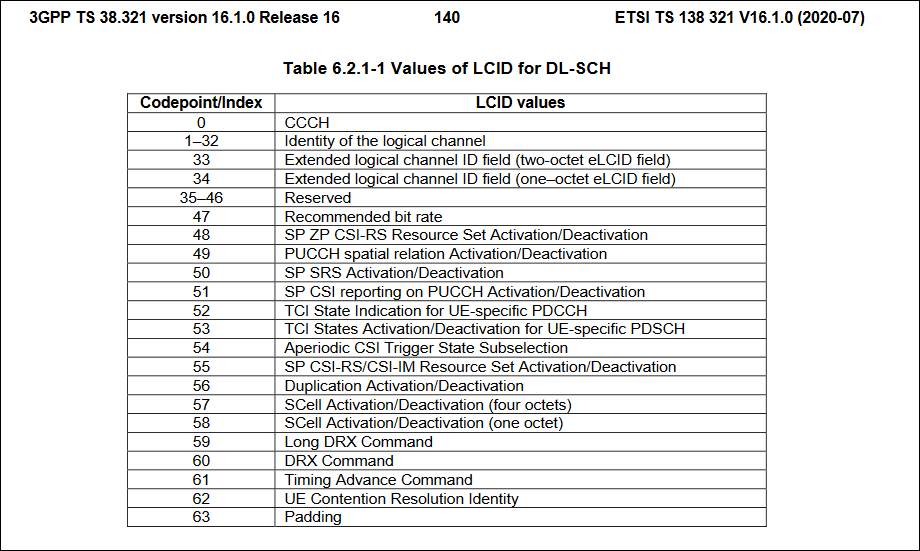
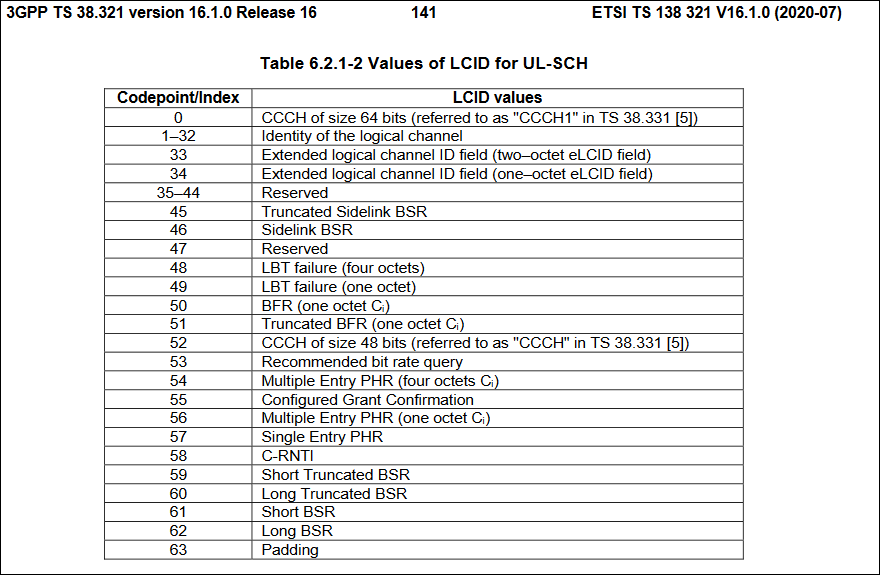
If you look at the MAC PDU, there are special structures that carries these information in the form of LCID (Logical Channel ID).
MAC CE are classified into UL and DL.
Each UL and DL have different types of MAC-CE.
Below table is taken from TS 38.321
MAC CE reference:
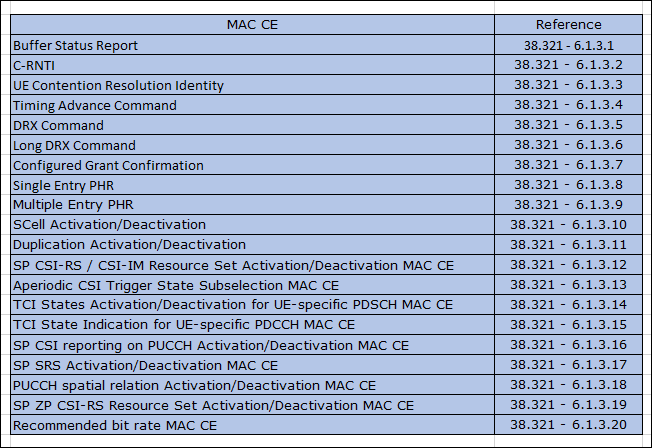
Brief of MAC CEs
1. MAC BSR (Buffer Status Report)
BSR is used to identify the total amount of data available across all logical channel groups after a MAC PDU has been built.
There are 3 different types of BSR:
– Short BSR format (fixed size); or
– Long BSR format (variable size); or
– Short Truncated BSR format (fixed size);
2. C-RNTI MAC CE
This CE will have the C-RNTI of the MAC entity.
3. UE Contention Resolution Identity MAC CE
This is used in RACH procedure. THe UE will get T C-RNTI over PDCCH and the MAC PDU will be decoded and UE will check this C-RNTI to check if it is same as that carried in MSG3 sent by UE.
4. Timing Advance Command MAC CE
It has the index value used to control the amount of timing adjustment that MAC entity has to apply.
5. DRX Command MAC CE
If the UE receives this CE, then it forces the UE to terminate the current active time and enter regular DRX cycle.
6. PHR MAC CE
Power Headroom Report is used to report the power headroom available in UE.
It indicates how much transmission power left for a UE.
7. SCell Activation/Deactivation MAC CEs
This CE is used to activate/deactivate secondary cell in CA case.
Source TS 38.321