In this chapter we shall learn, in how many ways a UE can request uplink grant to gNB.
UE can request uplink grant in 3 different ways:
1. Scheduling Request
2. Buffer Status Reporting
3. Random Access procedure
1. Scheduling Request (SR)
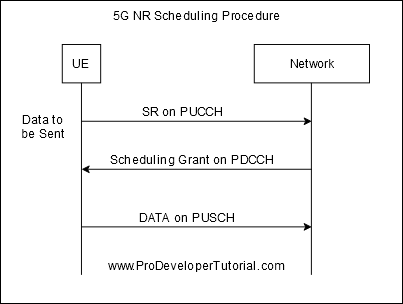
SR is used to request UL-SCH resources for new transmission.
A MAC entity may be configured with zero, one, or more SR configurations.
Each SR configuration corresponds to one or more logical channels.
RC configures the following parameters for the scheduling request procedure:
– sr-ProhibitTimer (per SR configuration);
– sr-TransMax (per SR configuration);
– sr-ConfigIndex.
The following UE variables are used for the scheduling request procedure:
– SR_COUNTER (per SR configuration)
5G NR scheduling Procedure
2. Buffer Status Reporting (BSR)
BSR is used to indicate base station that a UE has uplink data waiting to be transferred.
They are sent using PUSCH using BSR MAC CE.
There are 3 different types of BSR:
1. Regular BSR: If there a new data for uplink transmission, then Regular BSR is triggered
2. Periodic BSR: This is sent periodically to the base station.
3. Padding BSR:
3. Random Access procedure
Uplink grant will sent in Msg2 i.e RAR (Random Access Response).
UE will decode DCI 1_0 format with CRC scrambled by the corresponding RA-RNTI.
First UE will decode PDCCH, then it decodes PDSCH that carries RAR data.
By decoding it, UE will be able to get:
-timing advance
-uplink grant and
-the Temporary C-RNTI assignment
Source TS 38 321